Thoai
Thoai1. Introduction
gRPC is an open-source, high-performance Remote Procedure Call (RPC) framework developed by Google. It enables efficient communication between services by allowing clients to directly call methods on a server application as if it were a local object.
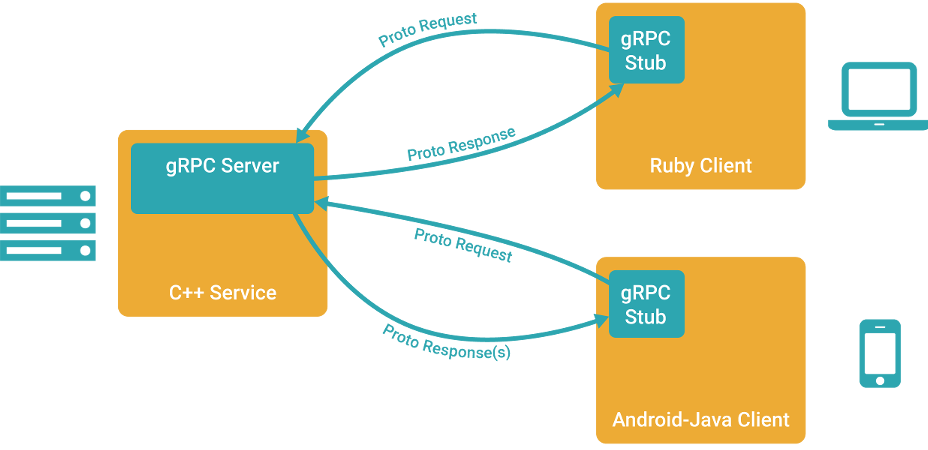
gRPC uses Protocol Buffers for defining service interfaces and message structures, and it operates over HTTP/2, providing features like bi-directional streaming, flow control, and low latency. It’s widely used for connecting distributed systems and microservices across various programming languages.
2. gRPC vs RESTful
gRPC, built on HTTP/2, uses Protocol Buffers (protobuf) for compact, binary serialization, making it faster, more efficient, and suitable for low-latency microservices. It also supports bi-directional streaming and strongly typed contracts but requires specific client libraries and is not natively browser-friendly.
In contrast, RESTful APIs, commonly using HTTP/1.1 and JSON/XML, are simpler, widely adopted, and more human-readable. They work seamlessly with browsers and are ideal for public APIs and CRUD-based applications, but they lack built-in streaming support and have higher overhead due to text-based data formats.
Ultimately, gRPC is best for high-performance, real-time applications, while RESTful APIs are more flexible and accessible for general web-based services. 🚀
| Feature | gRPC | RESTful API |
|---|---|---|
| Protocol | Uses HTTP/2 | Typically uses HTTP/1.1 (or HTTP/2 in some cases) |
| Data Format | Protocol Buffers (protobuf) (binary format) | JSON/XML (text-based format) |
| Speed & Performance | Faster due to binary serialization and HTTP/2 multiplexing | Slower due to text-based JSON/XML parsing and separate connections |
| Message Size | Smaller due to compact binary format | Larger because JSON is human-readable |
| Streaming Support | Yes (bi-directional streaming supported) | Limited (server-sent events, WebSockets) |
| Type Safety | Strongly typed with .proto files | Loosely typed (JSON schema optional) |
| Code Generation | Auto-generates client/server code in multiple languages | Requires manual code implementation |
| Interoperability | Requires gRPC libraries; not natively browser-friendly | Works with any HTTP client (browsers, mobile, etc.) |
| Browser Support | Limited (requires gRPC-Web proxy) | Fully supported in browsers |
| Security | Supports TLS encryption | Supports TLS and OAuth for security |
| Ease of Use | More complex due to protobuf and code generation | Simpler, widely adopted, human-readable |
| Best Use Cases | High-performance, low-latency, real-time applications, microservices | Web APIs, public APIs, CRUD-based applications |
3. Demonstration
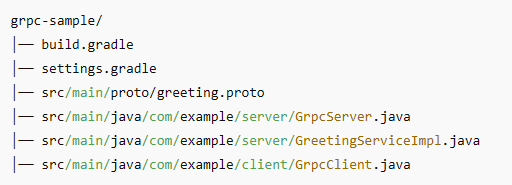
Here’s a basic gRPC project using Java with Gradle. This project includes:
- A gRPC server that provides a simple greeting service.
- A gRPC client that calls the service.
The project structure is as below:
3.1. Define the greeting.proto file
Create src/main/proto/greeting.proto:
syntax = "proto3";

package com.example;

option java_multiple_files = true;
option java_package = "com.example.grpc";

service GreetingService {
  rpc Greet (GreetRequest) returns (GreetResponse);
}

message GreetRequest {
  string name = 1;
}

message GreetResponse {
  string message = 1;
}
3.2. Update build.gradle
plugins {
    id 'java'
    id 'com.google.protobuf' version '0.9.4'
}

group = 'com.example'
version = '1.0'

repositories {
    mavenCentral()
}

dependencies {
    implementation 'io.grpc:grpc-netty-shaded:1.60.0'
    implementation 'io.grpc:grpc-protobuf:1.60.0'
    implementation 'io.grpc:grpc-stub:1.60.0'

    runtimeOnly 'org.apache.tomcat:annotations-api:6.0.53'
}

protobuf {
    protoc {
        artifact = 'com.google.protobuf:protoc:3.24.3'
    }
    plugins {
        grpc {
            artifact = 'io.grpc:protoc-gen-grpc-java:1.60.0'
        }
    }
    generateProtoTasks {
        all().each { task ->
            task.plugins {
                grpc {}
            }
        }
    }
}
3.3. Implement the Server
GrpcServer.java
package com.example.server;

import io.grpc.Server;
import io.grpc.ServerBuilder;
import java.io.IOException;

public class GrpcServer {
    public static void main(String[] args) throws IOException, InterruptedException {
        Server server = ServerBuilder.forPort(9090)
                .addService(new GreetingServiceImpl())
                .build();

        System.out.println("Starting gRPC server on port 9090...");
        server.start();
        server.awaitTermination();
    }
}
GreetingServiceImpl.java
package com.example.server;

import com.example.grpc.GreetRequest;
import com.example.grpc.GreetResponse;
import com.example.grpc.GreetingServiceGrpc;
import io.grpc.stub.StreamObserver;

public class GreetingServiceImpl extends GreetingServiceGrpc.GreetingServiceImplBase {
    @Override
    public void greet(GreetRequest request, StreamObserver<GreetResponse> responseObserver) {
        String greeting = "Hello, " + request.getName();
        GreetResponse response = GreetResponse.newBuilder().setMessage(greeting).build();

        responseObserver.onNext(response);
        responseObserver.onCompleted();
    }
}
3.4. Implement the Client
GrpcClient.java
package com.example.client;

import com.example.grpc.GreetRequest;
import com.example.grpc.GreetResponse;
import com.example.grpc.GreetingServiceGrpc;
import io.grpc.ManagedChannel;
import io.grpc.ManagedChannelBuilder;

public class GrpcClient {
    public static void main(String[] args) {
        ManagedChannel channel = ManagedChannelBuilder.forAddress("localhost", 9090)
                .usePlaintext()
                .build();

        GreetingServiceGrpc.GreetingServiceBlockingStub stub = GreetingServiceGrpc.newBlockingStub(channel);

        GreetRequest request = GreetRequest.newBuilder().setName("User").build();
        GreetResponse response = stub.greet(request);

        System.out.println("Response: " + response.getMessage());

        channel.shutdown();
    }
}
3.5. Build and Run
./gradlew build
./gradlew runServer
./gradlew runClient
The client output should be ‘Response: Hello, User’
4. Conclusion
gRPC is a powerful and efficient RPC framework that enables fast, scalable, and cross-platform communication between services. With support for multiple programming languages, and built-in features like streaming, authentication, and load balancing, gRPC is well-suited for modern microservices architectures.
By leveraging Protocol Buffers for serialization, it achieves high performance while maintaining flexibility and ease of use. As organizations continue to build distributed systems, gRPC provides a reliable foundation for efficient service-to-service communication. This demo application can be found on GitHub.